

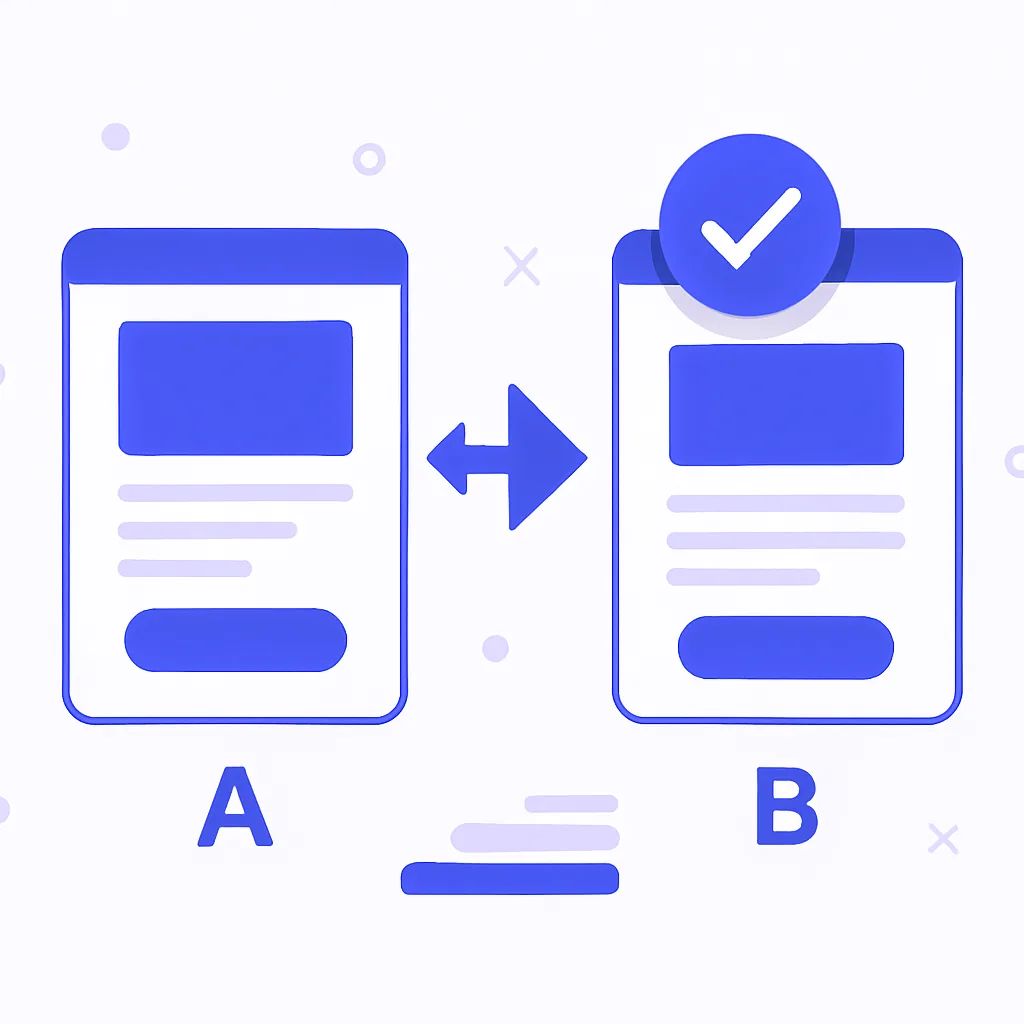
A/B testing (also called split testing) is a method of comparing two versions of a webpage, app screen, email, or other asset to see which performs better. You change one element, show each version to similar audiences at the same time, and measure which wins on a clear metric like conversion rate.
What Is A/B Testing?
A/B testing compares two versions of a marketing asset, a webpage, email, or app interface, to determine which performs better, using real user data instead of guesswork.
How A/B Testing Works 🧪
| Step | What you do |
|---|---|
| 1. Form a hypothesis | e.g. "a red button will convert better than blue", one change, one goal |
| 2. Create two versions | Version A (control) vs Version B (variant), changing only one element |
| 3. Split the audience | Random traffic split, same time period, equal sample sizes |
| 4. Measure results | Track the key metric, check statistical significance |
| 5. Ship the winner | Implement the better version, document learnings, plan the next test |
👆 Google once tested 41 shades of blue to pick the perfect link color, that's how granular A/B testing can get.
Why A/B Testing Matters
- Removes guesswork: decisions based on data, not hunches.
- Boosts conversion rates: small wins compound on existing traffic.
- Cost-effective: optimize the traffic you already have.
- Reveals behavior: tests show what actually motivates your audience.
What Can You A/B Test?
- Headlines and copy
- Call-to-action buttons (color, size, wording)
- Images and videos
- Layout and page design
- Pricing structures and offers
- Email subject lines
Key Metrics in A/B Testing
- Conversion rate: share of users who take the desired action.
- Click-through rate (CTR): share who click a specific link.
- Bounce rate: share who leave without interacting.
- Time on page and revenue per visitor.
Best Practices & Common Mistakes
- Test one element at a time, so you know what caused the change.
- Run tests simultaneously, control for external factors like holidays.
- Use a large enough sample and run long enough, avoid premature, random-looking results.
- Confirm statistical significance before declaring a winner.
- Always act on results, and keep testing; optimization is continuous.
A/B Testing FAQ
What is A/B testing in simple terms?
Showing two versions of something (A and B) to similar audiences at the same time and measuring which performs better, so you can pick the winner based on data.
How long should an A/B test run?
Long enough to reach a statistically significant sample, usually at least one to two full business cycles (often 1–4 weeks). Stopping early risks acting on random noise.
What's the difference between A/B testing and multivariate testing?
A/B testing compares two versions differing by one element. Multivariate testing changes multiple elements at once to find the best combination, which needs much more traffic.
What tools are used for A/B testing?
Common tools include Optimizely, VWO, Unbounce, and analytics-integrated platforms. Many email and CMS tools also have built-in A/B testing.